The quickest way to understand the alice in wonderland animated characters is to separate them by role: Alice carries the story, the White Rabbit pulls her into Wonderland, the Cheshire Cat misleads and guides her, the tea party characters bring chaos, and the Queen of Hearts turns the nonsense into danger. If you are making a cast list, choosing a costume, or comparing the Disney film with the books, start with those roles before worrying about every minor character.
Who Are the Main Alice in Wonderland Animated Characters?
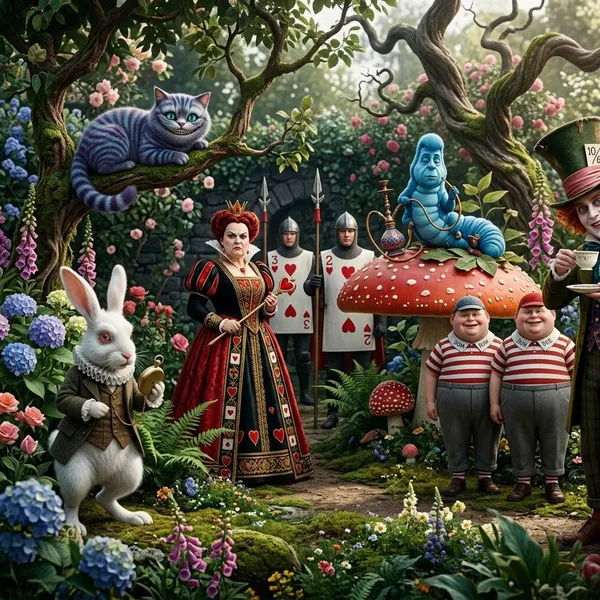
The main characters in Disney's 1951 Alice in Wonderland are Alice, the White Rabbit, the Cheshire Cat, the Mad Hatter, the March Hare, and the Queen of Hearts. They are the names most viewers remember because each one controls a major part of Alice's trip through Wonderland.
Alice as the curious girl exploring Wonderland
Alice is the main character and the viewer's anchor in a world that rarely behaves logically. She is curious enough to follow the White Rabbit, polite enough to keep trying with strange creatures, and frustrated enough to feel believable when Wonderland becomes too much.
In the 1951 Disney film, Alice was voiced by Kathryn Beaumont. Her calm, clear performance matters because the surrounding characters are so exaggerated; Alice gives the movie a human center instead of letting it become only a chain of strange scenes.
White Rabbit as the character who starts the adventure
The White Rabbit starts the story by giving Alice something to chase. His panic about being late makes him instantly memorable, but his real function is practical: he moves Alice from the ordinary world into Wonderland and keeps pulling her toward the next scene.
Cheshire Cat as the mysterious guide
The Cheshire Cat is a trickster rather than a straightforward helper. He often points Alice in a useful direction, but he does it with riddles, disappearing acts, and a grin that makes his motives feel unclear.
Mad Hatter and March Hare as the tea party duo
The Mad Hatter and March Hare are the center of the tea party scene, where ordinary manners collapse completely. They interrupt, celebrate unbirthdays, change the rules mid-conversation, and make Alice feel trapped in a social situation she cannot fix.
Their role is comedy first, but not gentle comedy. For Alice, the tea party is exhausting; for viewers, it is one of the clearest examples of how Wonderland turns familiar things into nonsense.
Queen of Hearts as the main antagonist
The Queen of Hearts is the main antagonist in Disney's animated film. Her temper, love of commands, and repeated threat of punishment make her the clearest danger Alice faces.
She works well as the final major threat because she turns Wonderland's silliness into something sharper. Earlier characters confuse Alice; the Queen can actually punish her, even if the danger is still exaggerated in a cartoon style.
Who Are the Supporting Characters in Alice in Wonderland?
The supporting characters add texture to Wonderland without carrying the whole plot. They are especially useful to know if you want a fuller cast list, a themed party lineup, or a comparison between the Disney film and Lewis Carroll's books.
Dormouse as the sleepy tea party guest
The Dormouse is the sleepy third guest at the tea party. He is quieter than the Mad Hatter and March Hare, but his drowsiness makes the scene funnier because it contrasts with their loud, frantic behavior.
Caterpillar as the wise questioner
The Caterpillar brings a slower, more thoughtful mood to the film. His question, "Who are you?" matters because Alice has been changing size, losing control, and trying to understand who she is inside a world that keeps shifting.
He is not warm or comforting, but he does give Alice useful direction. His scene is one of the better choices to focus on if you are discussing identity, growing up, or the more reflective side of the story.
Tweedledee and Tweedledum as playful twins
Tweedledee and Tweedledum are playful twin characters known for their matching designs, circular talk, and comic energy. They are strongly associated with Disney's Wonderland even though they come from Through the Looking-Glass, not the original Alice's Adventures in Wonderland.
For a book-versus-film comparison, they are important because they show how Disney blended Carroll's two Alice books into one animated movie.
King of Hearts and Dodo as supporting figures
The King of Hearts supports the Queen's court scenes by showing how weak and unstable Wonderland's authority can be. He has a royal title, but he rarely feels powerful beside the Queen.
The Dodo is a smaller figure, but he is often noted because readers have connected him with Lewis Carroll, whose real surname was Dodgson. That makes him more interesting in a literary context than in a simple "main cast" list.
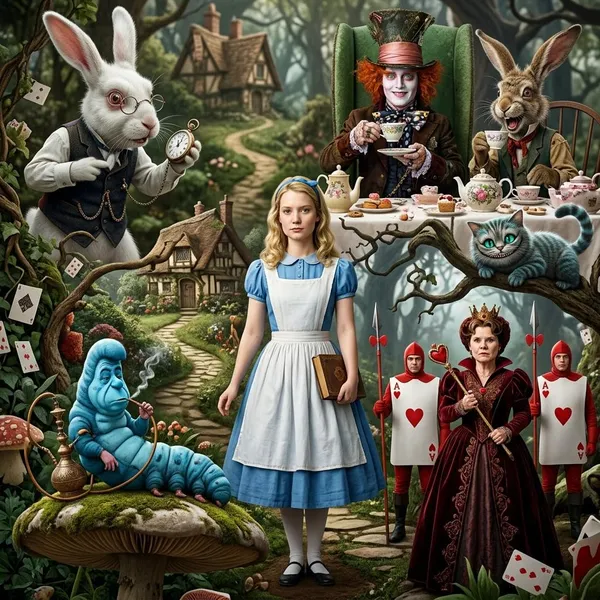
How Are the Alice in Wonderland Characters Connected?
The characters are connected less by a traditional mission and more by Alice's movement through Wonderland. She meets one strange personality after another, and each encounter teaches her that this world has its own unstable logic.
Alice and the Wonderland creatures
Alice is the outsider among the Wonderland creatures. She tries to be polite, ask clear questions, and follow normal rules, but most creatures answer with nonsense, riddles, or impatience.
That outsider position is why Alice works so well for younger viewers. A child watching for the first time may not understand every joke, but they can understand the feeling of being surrounded by adults who speak confidently while making very little sense.
Alice and the Queen of Hearts conflict
Alice's conflict with the Queen of Hearts is the film's most direct clash. The Queen represents unfair authority: she reacts before thinking, makes threats quickly, and expects everyone to obey her mood.
The conflict also gives the ending more force. Wonderland has been confusing from the beginning, but the Queen shows what happens when confusion is backed by power.
The tea party characters and their chaotic world
The tea party characters are connected by shared disorder. The Mad Hatter, March Hare, and Dormouse create a scene where time, manners, and conversation all feel broken.
If you are choosing characters for a group costume or themed display, this trio works better together than separately. The humor comes from the group dynamic: the Hatter's energy, the Hare's wildness, and the Dormouse's sleepy interruptions.
The royal characters and Wonderland rules
The royal characters show that even Wonderland's "rules" are unreliable. The Queen gives commands, the King stands nearby, and the court behaves as if ceremony exists, but fairness is missing.
- What looks official: crowns, trials, guards, and royal commands.
- What actually controls the scene: the Queen's temper.
- What Alice learns: authority is not the same as justice.
Character Roles in Disney's Alice in Wonderland
Sorting the cast by role is often more useful than memorizing every name. It helps you decide who belongs in a short main-character answer, who to include in a fuller list, and which characters matter most for a specific purpose.
| Role to identify | Best characters to use | When this is most useful |
|---|---|---|
| Main story focus | Alice | Basic summaries, school answers, first-time viewing |
| Movement through Wonderland | White Rabbit, Cheshire Cat, Caterpillar | Explaining how Alice gets from scene to scene |
| Comedy and chaos | Mad Hatter, March Hare, Dormouse, Tweedledee and Tweedledum | Party themes, costume groups, memorable scene lists |
| Conflict and danger | Queen of Hearts, royal court | Villain questions and plot tension |
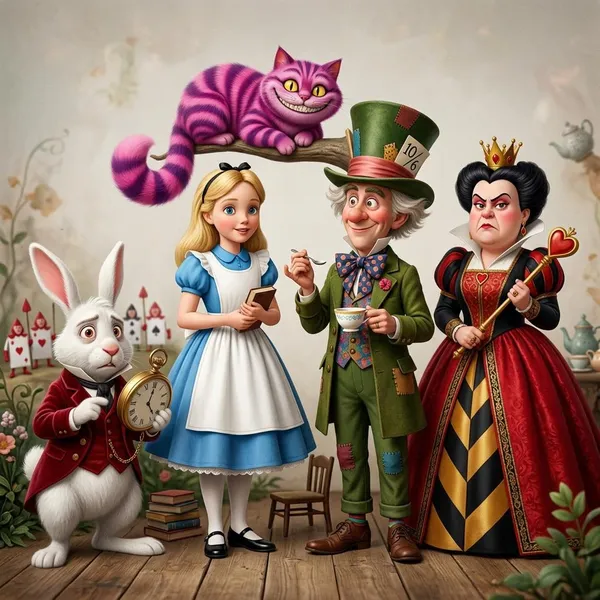
Animated Characters From Alice in Wonderland Books and Film
Disney's animated film is based mainly on Alice's Adventures in Wonderland, but it also borrows from Through the Looking-Glass. That is why some characters feel like they belong to the same world on screen even though they come from different books.
If you are comparing the movie with the books, check three things first: which book the character came from, whether Disney changed the role, and whether the animated design became more famous than the literary version.
Characters from Alice's Adventures in Wonderland
Many of the film's major figures come from Alice's Adventures in Wonderland, including Alice, the White Rabbit, the Caterpillar, the Cheshire Cat, the Mad Hatter, the March Hare, the Dormouse, the Queen of Hearts, the King of Hearts, and the Dodo.
These characters already had strong personalities on the page, which made them natural choices for animation. Disney heightened their voices, colors, movement, and comic timing rather than starting from nothing.
Characters changed for Disney's adaptation
Disney adjusted the cast to fit a feature-length animated movie. Some characters were simplified, some scenes were reshaped, and some book figures were left out because the film needed a faster rhythm.
- Tweedledee and Tweedledum: borrowed from Through the Looking-Glass.
- Mock Turtle and Gryphon: important book characters but not part of Disney's 1951 animated cast.
- Several minor figures: reduced or omitted so the film could focus on stronger set pieces.
This is the point most people miss when making a character list: "Alice in Wonderland" can mean the Disney movie, the first book, both Alice books, or the broader franchise. The right answer changes depending on which version you mean.
Characters that became Disney favorites
The Cheshire Cat, Mad Hatter, and Queen of Hearts became especially strong Disney favorites because their animated versions are easy to recognize at a glance. A grin, a hat, or a red-hearted royal design is enough to call the film to mind.
Alice and the White Rabbit also remain central to Disney's version of Wonderland, but for different reasons. Alice gives the story heart, while the White Rabbit gives it motion; the more flamboyant characters often dominate merchandise and theme imagery because their designs are bolder.
Conclusion
The best way to remember Disney's Wonderland cast is by function, not just by name: Alice is the center, the White Rabbit begins the chase, the Cheshire Cat complicates the path, the tea party characters supply comic disorder, and the Queen of Hearts gives the story its sharpest threat. Once those roles are clear, the supporting characters are much easier to place, whether you are rewatching the film, making a cast list, or comparing the animation with Carroll's books.