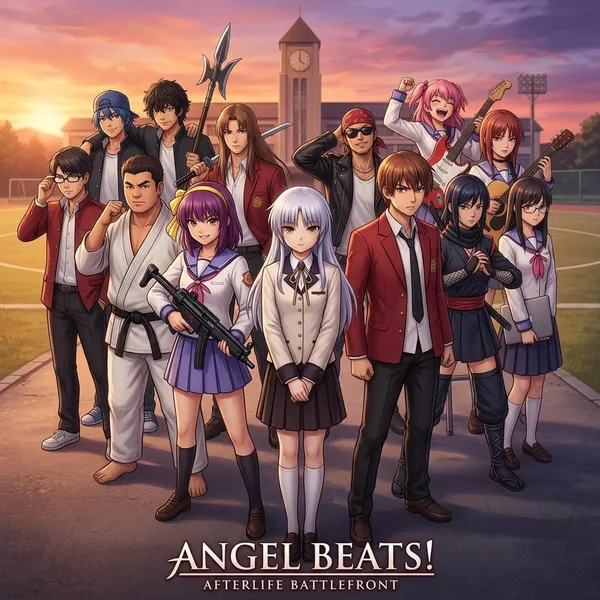
If you are trying to sort the anime angel beats characters by importance, start with Otonashi, Yuri, Kanade, and Hinata, then add Yui, Naoi, Iwasawa, and the wider Afterlife Battlefront around them. The series has a large cast for a short anime, so the useful way to read the characters is by role: who drives the mystery, who carries the emotional arcs, and who makes the afterlife school feel alive.
Who Are the Main Angel Beats Characters?
The main Angel Beats! cast is built around four characters who make the story easy to follow: Otonashi as the newcomer, Yuri as the rebel leader, Kanade as the misunderstood "Angel," and Hinata as the friend who keeps the group human. If you are watching for the first time, these are the names to remember before trying to track every SSS member.
Yuzuru Otonashi as the main protagonist
Yuzuru Otonashi is the main protagonist because the story begins with his confusion. He wakes up in the afterlife without his memories, which makes him the safest character for new viewers to follow: when he asks questions, the audience gets answers too.
His role changes once his past becomes clearer. Otonashi is not just there to observe the Battlefront; he gradually becomes the person who looks for a kinder answer than endless rebellion. That makes him central to both the plot and the emotional resolution.
Yuri Nakamura as the Afterlife Battlefront leader
Yuri Nakamura leads the Afterlife Battlefront, also known as the SSS. She is sharp, decisive, and willing to act before she has every answer, which is why the group rallies around her in such a strange world.
Kanade Tachibana as the mysterious Angel
Kanade Tachibana is called Angel by the Battlefront, but that label says more about their fear than her true nature. Her quiet behavior, unusual abilities, and lack of explanation make her look like an enemy early on.
Pay attention to what Kanade actually does, not only what other characters say about her. That is where the series starts to shift from a simple "students versus Angel" conflict into something more thoughtful and emotional.
Hideki Hinata as Otonashi's close friend
Hideki Hinata is Otonashi's closest friend in the group and one of the easiest characters to like quickly. He brings humor without feeling disposable, and his loyalty helps Otonashi feel less like an outsider.
Who Are the Supporting Angel Beats Characters?
The supporting cast matters because Angel Beats! is not only about solving the afterlife mystery. It is also about seeing different kinds of regret, loneliness, and unfinished wishes through characters who may only get a few major scenes.
Yui as the energetic musician
Yui starts as loud, chaotic, and almost too much on purpose. She brings a burst of comedy to Girls Dead Monster and the SSS, but her energy also hides one of the series' more vulnerable character arcs.
Her importance becomes clearer when the anime connects her personality to what she never got to experience in life. For viewers who prefer emotional payoff over plot mechanics, Yui is one of the supporting characters most worth paying attention to.
Ayato Naoi as the former enemy
Ayato Naoi begins as an antagonist through his position in the student council and his use of hypnotic control. His early scenes feel more uncomfortable than many of the Battlefront's slapstick fights because he brings psychological pressure into the story.
Naoi's shift from enemy to ally is not perfectly smooth, which actually suits the anime. He shows that some characters in the afterlife are not simply sad or heroic; they are damaged, proud, and still learning how to be accepted.
Masami Iwasawa as Girls Dead Monster's leader
Masami Iwasawa is the original lead singer of Girls Dead Monster and one of the earliest characters to show how emotional closure works in Angel Beats!. Her music is not just background style; it gives voice to pain she could not fully express before.
Other Afterlife Battlefront members
Other SSS members such as TK, Shiina, Noda, Matsushita, Ooyama, Takamatsu, and Fujimaki give the group its chaotic identity. Most do not receive the same depth as Otonashi or Yuri, but they stop the Battlefront from feeling empty.
- TK stands out through style, movement, and strange English lines.
- Shiina adds discipline and a sharper combat presence.
- Noda shows intense loyalty to Yuri, often in an exaggerated way.
- Ooyama and the others help make the school setting feel social rather than symbolic.
How Are the Angel Beats Characters Connected?
The relationships in Angel Beats! matter more than the action setup suggests. Early on, the cast seems divided by sides: the Battlefront against Angel, students against the system, rebels against acceptance. As the story develops, those labels become less reliable.
Otonashi and Kanade's relationship
Otonashi and Kanade's relationship is the turning point of the series. He begins by hearing that she is dangerous, but he gradually judges her through her actions instead of accepting the group's nickname for her.
That difference matters. Otonashi's willingness to question the Battlefront's assumptions opens the door to trust, and trust is what changes the story from a fight against an enemy into a story about understanding, gratitude, and release.
Otonashi and Yuri's shared goals
Otonashi and Yuri both want to protect the students, but they do not define protection the same way. Yuri's instinct is to resist the system that hurt them; Otonashi slowly moves toward helping people make peace with what they carried into the afterlife.
The Afterlife Battlefront members and their bonds
The SSS is held together by more than strategy. Its members share fear, resentment, jokes, routines, and the comfort of not being alone. That is why even silly missions matter: they give students a reason to stay connected.
- They begin with opposition: Kanade gives the group a target and a reason to act.
- They become a social home: the Battlefront gives lonely students identity and routine.
- They eventually face letting go: the same bonds that delay acceptance can also make acceptance possible.
Girls Dead Monster and emotional storytelling
Girls Dead Monster connects the anime's music, comedy, and grief. The band can be used as a distraction during operations, but its bigger function is emotional: it lets characters express what ordinary conversation cannot carry.
Which Angel Beats Characters Matter Most?
Importance in Angel Beats! depends on what you are trying to understand. For the main plot, Otonashi, Yuri, and Kanade matter most. For the emotional impact, Hinata, Yui, Iwasawa, and Naoi become harder to ignore.
| What you care about | Characters to focus on first |
|---|---|
| Main mystery and ending | Otonashi, Kanade, Yuri |
| Battlefront leadership and conflict | Yuri, Otonashi, Naoi |
| Emotional one-episode impact | Iwasawa, Yui, Hinata |
| Group personality and fan memory | Hinata, TK, Shiina, Noda, other SSS members |
Conclusion
The cast of Angel Beats! is easiest to understand when you separate story importance from emotional importance: Otonashi, Yuri, and Kanade carry the central conflict, while Hinata, Yui, Iwasawa, Naoi, and the SSS members give the series its warmth and aftertaste. If you only remember one thing, remember that the best anime angel beats characters are not memorable because they are powerful; they are memorable because each one shows a different way of holding on, being seen, and finally letting go.