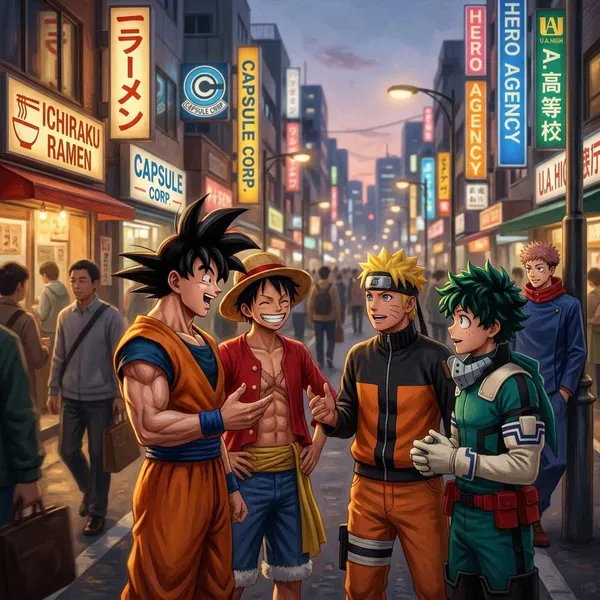
The safest way to count anime characters that appear in other anime is to look for official identity, not just a familiar design. Goku standing beside Luffy, Conan facing Lupin III, or the Isekai Quartet cast sharing a classroom all count because the characters appear as themselves and the collaboration is intentional.
Famous anime characters that appear in other anime
Some crossover appearances are easy to verify because they are promoted as special events or collaboration episodes. Others are lighter, so the useful question is not just "did they show up?" but "did the character keep the same identity and actually matter in the scene?"
Goku appears with Luffy and Toriko in Dream 9
Goku officially appears with Luffy and Toriko in Dream 9 Toriko & One Piece & Dragon Ball Z Super Collaboration Special!! This is one of the cleanest crossover examples because it brings together three major Shonen Jump heroes in a promoted TV special.
It also passes the practical test: Goku is not a background gag, Luffy is not a lookalike, and Toriko is not just mentioned. They share scenes, compete, react to each other, and behave like the characters fans already know.
Gintoki, Kagura, and Shinpachi appear in SKET Dance
Gintoki, Kagura, and Shinpachi appear in SKET Dance through an official crossover episode. The reason this one works so well is tone: Gintama and SKET Dance both rely on fast comedy, straight-man reactions, and self-aware jokes.
Bossun, Himeko, and Switch appear in Gintama
The crossover also goes the other way: Bossun, Himeko, and Switch from SKET Dance appear in Gintama. That two-way exchange makes the collaboration feel less like a quick publicity stunt and more like both shows were willing to play with each other's cast properly.
For a casual viewer, the episode still works as comedy. For someone checking whether it "counts," the important parts are all there: the characters are identified, they interact with the host cast, and their usual group dynamic remains recognizable.
Lupin III crosses paths with Detective Conan
Lupin III vs. Detective Conan is a stronger crossover than a simple guest appearance because both franchises bring their main appeal into the same story. Conan solves problems through deduction, while Lupin creates trouble through confidence, disguise, and elaborate planning.
That contrast gives the crossover a reason to exist beyond fan service. If you prefer mystery and cat-and-mouse tension over one-off comedy cameos, this is one of the most satisfying anime crossover projects to start with.
Arale appears in Dragon Ball
Arale from Dr. Slump appears in Dragon Ball, helped by the fact that both series come from Akira Toriyama. Her appearance is playful rather than serious, but that does not make it less valid.
The key is that Arale brings her own gag-comedy logic with her. She is still absurdly energetic, ridiculously strong, and tonally disruptive in the exact way fans expect from Dr. Slump.
Conan appears in Star Detective Precure
Conan's appearance in Star Detective Precure is better treated as a lighter collaboration-style case than a full story crossover like Lupin III vs. Detective Conan. The useful distinction is scale: some appearances are major crossover events, while others are official promotional or special-format appearances.
Anime built around crossover casts
Some anime do not use crossovers as a surprise. They are built around the idea from the start, which removes most of the ambiguity. Instead of asking whether a guest appearance counts, the fun comes from watching characters from different worlds react to the same setting.
Isekai Quartet brings Ainz, Kazuma, Subaru, and Tanya together
Isekai Quartet brings together Ainz from Overlord, Kazuma from KonoSuba, Subaru from Re:ZERO, and Tanya from The Saga of Tanya the Evil. It is openly framed as a crossover, so viewers do not need to hunt for hidden references.
The school setup is a smart choice because it avoids forcing every original plotline into one complicated timeline. Ainz can remain imposing, Kazuma can complain, Subaru can overreact, and Tanya can stay intense while the comedy comes from putting those personalities in ordinary classroom situations.
Shield Hero characters join Isekai Quartet 2
Isekai Quartet 2 adds characters from The Rising of the Shield Hero, including Naofumi, Raphtalia, and Filo. This changes the group chemistry because Naofumi brings a more guarded and skeptical presence than many of the louder comedy-first characters.
Shadow joins Isekai Quartet 3
Shadow from The Eminence in Shadow fits the Isekai Quartet 3 idea because his dramatic self-image already sits close to parody. A character who treats every moment like a grand performance naturally plays well against a cast full of overpowered leaders, unlucky heroes, and deadpan schemers.
- Watch for comedy first: crossover ensemble shows usually prioritize character reactions over canon development.
- Know at least one franchise: the jokes land faster when you recognize a few original personalities.
- Do not treat every scene as timeline evidence: many ensemble crossovers are official but not meant to rewrite the main stories.
How can you spot an official crossover?
Start with the strongest evidence first: same identity, official confirmation, and real interaction. A poster in the background or a suspiciously familiar hairstyle can be fun, but it is usually not enough to call something a true crossover.
The character keeps the same identity
A real crossover normally keeps the character's name, personality, and role recognizable. Goku should still feel like Goku; Conan should be treated as Conan, not as a generic child detective joke.
Official sources confirm the collaboration
Official confirmation is the easiest way to separate a documented crossover from fan interpretation. Check episode titles, production announcements, studio posts, publisher notices, streaming descriptions, or promotional campaigns.
The character interacts with the other cast
Interaction gives an appearance weight. A guest character who talks to the host cast, joins a conflict, affects a joke, or changes the direction of a scene is much easier to count than someone standing silently in the background.
- Strong sign: named dialogue, shared scenes, or plot involvement.
- Weak sign: a poster, crowd shot, costume reference, or one-frame visual gag.
- Middle ground: a brief official cameo that is confirmed, but not central to the story.
The appearance goes beyond a visual reference
The final check is purpose. A crossover appearance is intentional as a character meeting; a visual reference is usually just a joke for attentive viewers.
- Check the name: is the character named in the episode, credits, or official promotion?
- Check the role: do they speak, react, compete, investigate, fight, or influence the scene?
- Check the source: did the rights holders or production side promote the collaboration?
- Check the category: is it a full crossover, a short official cameo, a shared-universe appearance, or just an Easter egg?
Conclusion
The best anime crossover appearances are easy to defend: the character stays the same person, the collaboration is official, and the scene uses them for more than decoration. If you want the clearest examples, start with Dream 9, Lupin III vs. Detective Conan, the Gintama and SKET Dance exchange, Arale in Dragon Ball, and Isekai Quartet; if an appearance lacks identity, confirmation, or interaction, treat it as a reference until proven otherwise.