Asian anime characters are not all the same kind of representation: some are Japanese because the story is set in Japan, some are clearly Chinese or Korean, and some come from fictional worlds built with Asian cultural influences. The quickest way to classify a character is to check what the story actually confirms first, then use setting, names, and worldbuilding as supporting clues.
Japanese anime characters
Japanese characters are the easiest group to miss because anime often treats the setting as obvious instead of repeatedly stating nationality. If a series takes place in Japanese schools, cities, homes, train stations, shrines, or workplaces, the main cast is usually meant to be read as Japanese unless the story says otherwise.
Light Yagami from Death Note
Light Yagami is a strong example of a Japanese character whose normal setting makes the horror sharper. He begins as a top student in a recognizable Japanese family and school environment, which makes his shift into Kira feel less like a fantasy villain origin and more like a moral collapse inside ordinary life.
Satoru Gojo from Jujutsu Kaisen
Satoru Gojo is globally recognizable, but his character is still rooted in a Japanese supernatural-action framework. Tokyo Jujutsu High, curses, inherited techniques, and hidden institutions beneath modern Japan all place him in a specifically Japanese story world.
Usagi Tsukino from Sailor Moon
Usagi Tsukino matters because she made an ordinary Japanese schoolgirl the emotional center of a magical girl classic. Her grades, friendships, family moments, and clumsy everyday habits are not filler; they are what make her courage feel warm and believable.
Shinji Ikari from Neon Genesis Evangelion
Shinji Ikari is often discussed as a reluctant hero, but he is more than a general symbol of teenage anxiety. Neon Genesis Evangelion builds him out of Japanese mecha tradition, social pressure, emotional restraint, and institutional control.
If you are comparing him with more confident action leads, the key difference is not only personality. Shinji's Japanese media context shapes why his silence, hesitation, and need for approval feel so central to the story.
Chinese and Chinese descended anime characters
Chinese and Chinese descended characters need a little more care because fans often mix confirmed identity with cultural coding. A character may be directly Chinese, Chinese American, or descended from a Chinese family; another may only live in a fantasy world inspired by China.
Revy from Black Lagoon
Revy is Chinese American, which makes her one of the clearest Chinese descended characters in anime. Black Lagoon does not present her as a polished representation figure; she is violent, damaged, funny, cruel, and defensive, often all in the same episode.
That roughness is part of why she stands out. Her background informs how viewers read her anger and survival instincts, but the story does not reduce her to heritage alone.
Hei from Darker than Black
Hei is commonly recognized as a Chinese character in anime, and his cool, restrained presence makes him memorable without relying on loud cultural markers. His identity sits alongside the espionage, supernatural powers, and emotional distance that define Darker than Black.
He is a good example for viewers who want non-Japanese Asian characters but do not necessarily want a story centered on ethnicity. His background is part of the character, not the only reason he matters.
Shampoo from Ranma 1/2
Shampoo is one of the most famous Chinese characters from classic anime comedy. She comes from a Chinese village, fights with martial arts confidence, and brings chaos into Ranma 1/2 with a very recognizable presence.
That makes her both important and worth discussing carefully. She is memorable, but she also shows how representation standards have changed over time.
Korean anime characters
Korean characters are less common in Japanese-produced anime than Japanese characters, but they have become much more visible through anime-style adaptations of Korean webtoons. The God of High School is one of the clearest entry points because its main cast, names, and setting are plainly Korean.
Jin Mori from The God of High School
Jin Mori is the energetic center of The God of High School. He is competitive, cheerful, and easy to follow as an action lead, but he is not just a generic fighter with a Korean name. The school environment, tournament structure, and cultural setting make his background clear.
If you want a straightforward Korean-led anime-style action series, Jin is probably the simplest starting point. There is no need to infer his identity from design alone because the story world already supports it.
Han Daewi from The God of High School
Han Daewi gives the main trio a steadier emotional balance. Compared with Jin's restless energy, Daewi feels more grounded and serious, which keeps the group from becoming one-note.
His appeal also comes from motivation. Even in a series built around big fights, Daewi has personal stakes that make his choices feel less like tournament mechanics and more like character drama.
Yoo Mira from The God of High School
Yoo Mira broadens the Korean cast beyond two male action leads. Her sword-based fighting style gives her a clear visual identity, while her goals keep her from feeling like a side character placed only to complete the team.
Asian inspired characters from fictional worlds
Some characters feel strongly Asian but do not belong to real Asian countries. Fantasy kingdoms, imperial courts, alien societies, and alternate worlds may borrow from Chinese, Japanese, Korean, Central Asian, or broader Asian cultures while still remaining fictional.
The safest phrasing is usually "Asian-inspired" or "inspired by Chinese court culture" when the series does not confirm a real-world nationality. That is not a downgrade. In many cases, fictional settings contain some of the richest cultural worldbuilding in anime.
Ling Yao from Fullmetal Alchemist Brotherhood
Ling Yao is from Xing, not real-world China. Xing is a fictional country in Fullmetal Alchemist Brotherhood, but its court politics, names, succession struggles, and visual cues are strongly influenced by Chinese imperial culture.
Maomao from The Apothecary Diaries
Maomao is one of the strongest modern examples of an Asian-inspired protagonist because her setting is shaped by Chinese imperial court life, medicine, hierarchy, rumor, and domestic politics. Her intelligence matters more than physical power: she observes, tests, notices small inconsistencies, and avoids saying more than she needs to.
Kagura from Gintama
Kagura is harder to classify neatly because Gintama mixes parody, science fiction, historical references, and exaggerated character comedy. She uses Chinese-style visual and genre cues, but the series is too playful to treat those signals as strict real-world nationality.
She still belongs in this conversation because she is more than a quick gag. Kagura is funny, fierce, emotionally important, and central to the main group, which gives her cultural coding more weight than a throwaway joke would have.
Why Asian character backgrounds can be confusing
Confusion usually comes from treating several different things as one label. A character can be Japanese by setting, Chinese American by ancestry, Korean through source material, or Asian-inspired through fantasy worldbuilding. Those categories overlap in fan discussion, but they are not identical.
Nationality and ethnicity are not the same
Nationality usually means belonging to a country, while ethnicity is more about ancestry, heritage, or cultural background. Revy is a useful example because "American" and "Chinese descended" can both be relevant, depending on what question you are asking.
Before arguing over a label, it helps to ask whether you mean where the character lives, what country they belong to, or what their family background is. Those answers may not always match.
Fictional countries can borrow real Asian cultures
Fictional countries often borrow heavily from real cultures without becoming exact versions of them. Xing in Fullmetal Alchemist Brotherhood resembles imperial China, and The Apothecary Diaries draws strongly from Chinese court life, but neither should automatically be treated as a direct modern nationality label.
Character design alone does not confirm ethnicity
Character design is the weakest evidence. Hair color, eye shape, clothing style, and facial features in anime are often chosen for mood, genre, comedy, or recognizability rather than realistic ethnicity.
- A blond student in Tokyo may still be Japanese.
- A dark-haired prince in a fantasy empire may be culturally inspired without having a real-world nationality.
- A character with Chinese-style clothing may be coded that way, but the story still needs to confirm identity.
If the series gives no direct answer, cautious wording is better than a confident claim the story never supports.
Conclusion
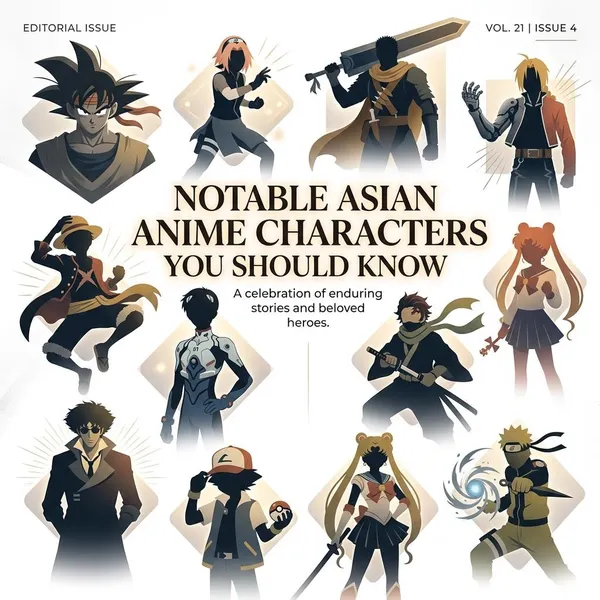
The most useful way to think about Asian anime characters is to separate confirmed background from cultural influence. Light, Usagi, Gojo, and Shinji are rooted in Japanese settings; Revy, Hei, and Shampoo give clearer Chinese or Chinese descended examples; Jin, Daewi, and Mira show Korean representation through anime-style adaptation; Ling, Maomao, and Kagura are better understood through fictional worlds shaped by Asian cultures. If you check the story first and use design only as a clue, the labels become much easier to discuss without flattening every character into the same broad category.