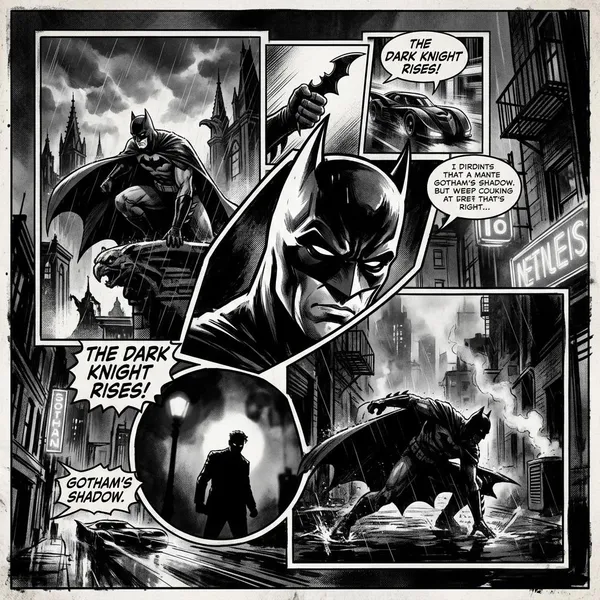
Batman Black and White motion comics are best approached as short comic adaptations with sound and movement, not as regular Batman cartoons. There are 20 self-contained stories, and the strongest ones work because they lean into noir mood, sharp character ideas, and the original black-and-white artwork instead of trying to imitate full animation.
Which stories stand out most?
The easiest way to choose where to start is to match the short to the kind of Batman story you like. If you want horror, start with Here Be Monsters. If you want a hard street-level Batman, try Broken Nose. If villain psychology is more your thing, Two of a Kind and Case Study are better entry points.
Here Be Monsters for psychological horror
Here Be Monsters stands out because it treats Batman less like an action hero and more like someone trapped inside a nightmare. The limited movement actually helps here: slow framing, harsh shadows, and uneasy pauses make the story feel unstable in a way full animation might smooth over.
This is a good first pick if you like Batman stories where fear matters more than fighting. It is less about watching Batman beat someone and more about watching the mood close in around him.
Broken Nose for a bruising Batman story
Broken Nose is the better choice when you want Batman to feel human, tired, and stubborn. The story works because the pain is not decorative; it reminds you that Batman's real superpower is often endurance rather than invincibility.
Two of a Kind for a tragic Two-Face tale
Two of a Kind gives Harvey Dent real emotional weight instead of using Two-Face as a simple villain-of-the-week threat. The short is built around contradiction: hope against damage, control against collapse, and Batman orbiting a tragedy he cannot easily fix.
If you usually prefer Batman stories where the villain's inner life matters, this is one of the safest recommendations in the set.
Case Study for a different take on the Joker
Case Study is memorable because it looks at the Joker through a colder, more analytical lens. That makes the character feel less theatrical and more unsettling, especially because the story never fully lets you relax into one clean explanation.
- Watch it for: a quieter Joker story.
- Do not expect: a big chaotic action set piece.
- Why it fits the format: voice, silence, and still images carry the discomfort.
Perpetual Mourning for detective noir
Perpetual Mourning is the one to try if your favorite Batman is the detective moving through a wounded city. It has the patience of a crime comic: faces, clues, grief, and shadow do more work than punches.
How are the motion comics structured?
The 20 motion comics are arranged as an anthology, not as one long storyline. That means you can watch a single short, stop, and still feel like you got a complete Batman tale.
This structure is part of the appeal. A casual viewer can sample one or two stories without studying continuity, while a comic reader can enjoy how different creators approach Batman, Gotham, and the villains from very different angles.
Early releases pair two shorts together
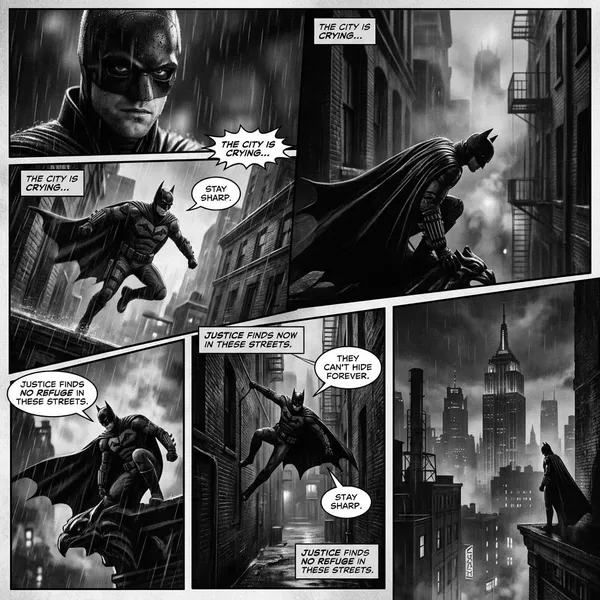
Early releases often pair two shorts together, which suits the format well because most entries are brief. A double-feature setup gives you enough variety in one sitting without turning the collection into a long commitment.
The pairings also make the tonal range obvious. One short might feel eerie or psychological, while the next plays more like crime noir. That contrast is useful if you are trying to decide whether the whole anthology is for you.
Each story works as a self-contained Batman tale
You do not need to watch the stories in a strict order. Each short introduces its own situation, follows its own mood, and lands its own ending.
Different creators bring distinct visual styles
The creator variety is not just a credit-list detail; it changes the experience from story to story. Some shorts feel rough and street-level, some are more stylized, and others lean into horror or clean noir composition.
- Comic readers may notice the preserved line work and page composition first.
- Animation-first viewers may notice the shifts in tone more than the artist differences.
- Newer Batman fans can treat the variety as a quick tour of how flexible the character is.
The anthology format connects all 20 stories
The 20 stories are connected by presentation and theme rather than continuity. Black-and-white art, short-form storytelling, Gotham's moral weight, and restrained motion give the set a shared identity even when the individual styles change.
How do they differ from Batman animation?
The biggest mistake is expecting these to move like regular animated episodes. Batman Black and White motion comics keep the comic artwork as the base, then add camera movement, sound, voices, and selective animation on top.
If you want fast fight choreography, they may feel too still. If you like comic panels, noir pacing, and atmosphere, the restraint becomes part of the appeal rather than a flaw.
Original comic artwork remains the foundation
The visual identity comes from the original comic art, not from redesigned animation models. That matters because Batman: Black and White depends heavily on contrast, composition, and artist-specific interpretation.
For readers who care about the source material, this is the main advantage. The adaptations do not just borrow the plot; they keep the look and mood of the printed stories close to the surface.
Camera movement creates motion between panels
Motion usually comes from pans, zooms, layered artwork, and transitions rather than fully animated bodies. A slow push toward Batman's face, a drift across a rooftop, or a pause on a villain's expression can guide your eye the way a comic panel does on the page.
Animation is intentionally limited
The limited animation is a design choice, though it will not work for everyone. It suits stories built around dread, investigation, memory, or villain psychology better than stories that need complex fight movement.
- Good fit: noir, horror, internal conflict, short mysteries.
- Weaker fit: viewers wanting fluid combat or Saturday-morning pace.
- Best mindset: watch it as a comic being performed, not as a low-frame-rate cartoon.
The pacing feels closer to a moving comic book
The pacing is slower and more deliberate than standard Batman animation. Scenes often linger on a face, a shadow, or a piece of narration, so the rhythm feels closer to turning pages than watching an action sequence.
Who will enjoy Batman Black and White motion comics?
These motion comics are easiest to recommend to people who already like Batman as a dark, graphic, noir-driven character. They are less ideal for someone who mainly wants polished action animation or a single serialized plot.
Comic readers who want faithful adaptations
Comic readers are probably the most natural audience because the format protects the original art instead of replacing it. If you care about panel composition, black-and-white contrast, and different artists' takes on Gotham, these shorts offer a screen version that still feels close to the page.
Fans of darker Batman stories
Fans of darker Batman stories should find plenty to enjoy, especially in shorts built around guilt, obsession, fear, and moral damage. The monochrome look makes Gotham feel harsher and more intimate than a brighter superhero style would.
Viewers who enjoy noir visuals
Noir is one of the format's strongest selling points. Alleys, rooftops, interrogations, and silent city spaces all benefit from the black-and-white treatment, especially when the camera movement is slow enough to let the compositions breathe.
- Try it if: you enjoy shadows, rain-soaked Gotham, and crime-story pacing.
- Skip or sample first if: you get bored when visuals hold still for mood.
Batman fans comfortable with limited animation
The viewers most likely to enjoy the full set are Batman fans who adjust their expectations early. These are not replacements for Batman: The Animated Series, animated films, or action-heavy adaptations. They are better as short mood pieces that keep the comic art in charge.
If you are unsure, start with one standout short rather than watching randomly. Case Study, Perpetual Mourning, or Here Be Monsters will tell you quickly whether the style clicks for you.
Conclusion
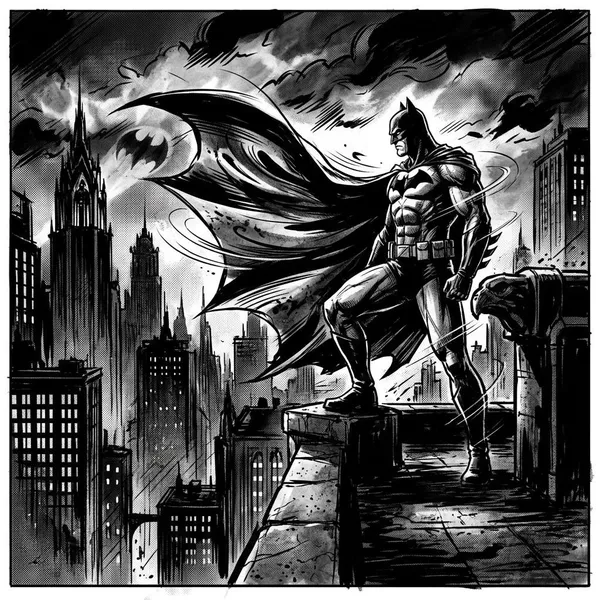
Batman Black and White motion comics are worth trying if you want Batman stories that feel closer to illustrated noir than conventional animation. Start with one of the stronger shorts, judge the format on mood rather than movement, and you will know quickly whether this stripped-down, shadow-heavy version of Gotham is your kind of Batman.