If you searched for an iron man motion comic, you are probably looking for Iron Man: Extremis. It is a six-part screen adaptation of the Warren Ellis and Adi Granov comic arc, using the original-style comic art with limited movement, voices, music, and sound instead of full animation.

What happens in Iron Man Extremis?
Iron Man: Extremis is built around one clear problem: Tony Stark's usual armor is no longer enough. A man named Mallen is transformed by the Extremis process, Iron Man is badly beaten, and Tony has to decide whether to change himself as well as his technology.
The story matters because it pushes Iron Man from "man inside a suit" toward something more integrated. If you only know Tony from the movies, this arc is useful because it shows one of the comic-book ideas behind the more modern version of Iron Man.
Mallen gains powers from the Extremis serum
Mallen becomes dangerous after taking Extremis, an experimental biological enhancement that rewrites the body. He is stronger, faster, harder to stop, and more violent than the kind of enemy Tony can usually outthink with better hardware.
That makes him feel less like a costumed villain and more like a weapon that escaped into public life. The threat is not just "Iron Man meets a stronger opponent"; it is biology catching up with, and briefly passing, Tony's machines.
Iron Man is defeated by the enhanced Mallen
The first major fight is supposed to feel one-sided. Tony brings experience and armor; Mallen brings speed, regeneration, and raw physical force that the suit cannot properly answer.
This is the point where the story becomes more than a normal superhero mission. For a casual viewer, it is the simple hook: Iron Man loses because his current setup is outdated. For a longtime comic reader, it is the pressure point that forces Tony into one of his more extreme decisions.
Tony uses Extremis to upgrade himself
Tony's response is not just to build a stronger suit. He uses Extremis on himself, turning his own body into part of the solution. That choice is risky because the same technology that created Mallen is now being used to remake Tony in a more controlled way.
- What he needs: faster reaction and deeper control.
- What he risks: changing his body in ways that are not just mechanical.
- Why it matters: the upgrade makes Iron Man feel like a new kind of hero, not simply a better-armored one.
The upgrade changes how Tony controls his armor
After the upgrade, Tony's armor is no longer just equipment he operates from the inside. The connection becomes faster and more direct, closer to an extension of his nervous system than a traditional machine interface.
How the motion comic adapts Extremis
The motion comic keeps the story close to the printed arc, but it changes how you experience it. Instead of controlling the reading pace yourself, you get guided timing, voice performances, sound effects, and small animated movements layered over comic-style visuals.
Your reaction will mostly depend on what you expect. If you want a full animated series, it may feel too still. If you enjoy comic art and want a more relaxed way to experience the story, the format makes sense.
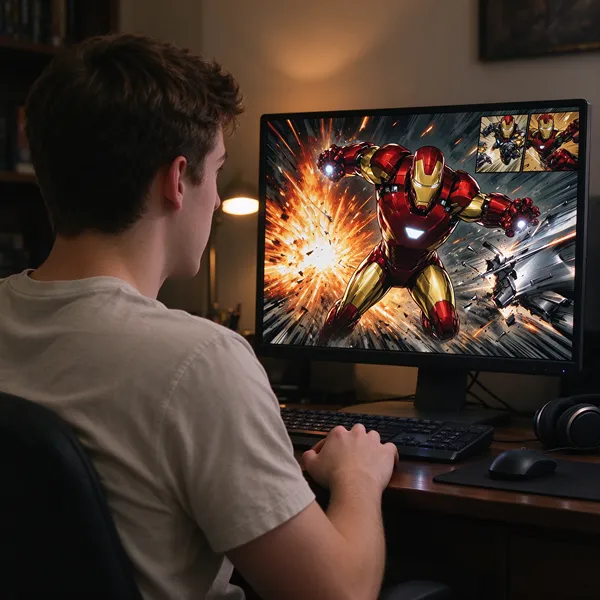
Adi Granov's comic art forms the visual base
Adi Granov's sleek, metallic Iron Man design is one of the main reasons Extremis still stands out. The motion comic's best choice is that it does not throw that look away. It keeps the armor, lighting, and grounded visual tone at the center of the adaptation.
Limited movement brings the panels to life
The movement is intentionally limited: pans, zooms, layered effects, small facial shifts, and action emphasis rather than full character animation. That works best in quieter or atmospheric moments, where the camera can draw your eye across the art.
The trade-off is obvious during action scenes. Someone expecting modern animated Marvel combat may find it stiff, while someone who mainly wants Granov's panels with extra atmosphere may find it easier to watch than read.
Voice acting and sound replace the silent reading experience
Sound is doing a lot of the work here. Voices set the tone of Tony's dialogue, music adds pressure, and impact effects make Mallen's attacks feel heavier than they would on a silent page.
This can help if you do not read many comics, because the performances guide the mood. The downside is that the production chooses the rhythm for you; the printed comic leaves more room for your own pacing and interpretation.
The six issue story becomes six screen episodes
The original Extremis arc ran for six issues, and the motion comic follows that shape with six episodes. That makes it easy to watch one chapter at a time without committing to a long series.
For a quick evening watch, the format is convenient. For someone comparing it to the comic issue by issue, the episode structure also helps because the major breaks still feel tied to the source material.
Iron Man Extremis motion comic vs the original comic
The motion comic and the original comic are not competing in a simple "better or worse" way. They tell the same core story, but they serve different habits: one is guided viewing, the other is controlled reading.
| Choose this version | If you mainly want |
|---|---|
| Original comic | Full page layouts, your own pacing, and the strongest look at Granov's art |
| Motion comic | The same story with voices, sound, and a lower-effort viewing experience |
Both follow the same core Extremis storyline
Both versions cover the essential arc: Mallen is enhanced, Tony is outmatched, Extremis becomes the turning point, and Iron Man's relationship with his armor changes. If your goal is simply to understand why Extremis is important, either format will get you there.
The comic preserves the original page layouts and pacing
The printed comic is still the better choice if you like to study panels, reread dialogue, or sit with a page longer than a screen adaptation allows. Granov's art benefits from that slower attention, especially in the armor details and cinematic compositions.
This is the version to choose if you already enjoy comics as a medium, not just as a source for superhero plots.
The motion comic adds voices, movement, and sound
The motion comic gives the story a more directed mood. Tony's lines are performed, battles have audio weight, and scene transitions move without you needing to manage the pace yourself.
That can be a real advantage for a viewer who bounces off comic pages but still wants the original Extremis storyline. It is less ideal if you dislike being told how a scene should sound or how long a moment should last.
Both work as accessible introductions to the Extremis story
For an MCU fan curious about the source idea behind Extremis, the motion comic is the easier first stop. For a comic fan who cares about the original creative work, the printed version is more rewarding.
Is Iron Man Extremis worth watching?
Iron Man: Extremis is worth watching if you want a faithful, compact version of an important Iron Man story and you are comfortable with the motion comic style. It is not the best pick if you mainly want fluid animation or a modern action-cartoon feel.
Check the format first before paying to rent or buy it. A short preview tells you more than any description can: if the limited movement bothers you in the first few minutes, the rest will probably feel the same.
Best for fans interested in the original Extremis story
This is the strongest reason to watch it. The motion comic gives you the key ideas without requiring a deep Iron Man reading list: Extremis as a biotech threat, Tony's defeat, his self-upgrade, and the new armor connection.
It works especially well as a bridge. If you are not sure whether the comic is worth buying or reading, the motion comic lets you test the story first.
Good for viewers who enjoy comic art with added motion
The adaptation is a good fit for viewers who like the look of comic panels but prefer having voices and sound carry the story forward. It is less about spectacle and more about preserving the art while making the experience easier to sit through on a screen.
Availability can change by region and platform, so the safest check is your current digital rental, purchase, or streaming options. Look specifically for Iron Man: Extremis, since that is the title most closely tied to this motion comic.
Conclusion
Iron Man: Extremis is a smart watch if you want the famous Extremis arc in a short, accessible format and do not mind limited animation. Read the original comic for the best version of the art and pacing; choose the motion comic when you want the same essential story with voices, sound, and a more passive viewing experience.