If you found the death of spider man motion comic online and want to know whether it is the real story, the short answer is: it is a fan-made motion-comic retelling of Ultimate Peter Parker's last stand, not an official Marvel film. It adapts the final part of the Ultimate "Death of Spider-Man" storyline, where Peter fights Green Goblin while already badly wounded and dies after protecting the people closest to him.
What happens in the Death of Spider-Man motion comic?
The motion comic focuses on the end of Ultimate Peter Parker's life rather than the whole comic arc. The important thing to know first is that Peter is not entering a normal superhero fight. He is injured, exhausted, and still chooses to stand between Green Goblin and his family.
For a casual viewer, the motion comic works as a fast emotional version of the story. For someone trying to understand the canon event, it should be treated as a visual retelling of comic material, not a replacement for reading the original issues.
Peter enters the final battle badly wounded
Peter is already in terrible condition before the final confrontation begins. That detail changes the meaning of the whole ending: he is not losing because he gives up or makes one simple mistake; he is fighting a battle his body can barely survive.
The motion-comic format makes this easy to feel through pauses, close-ups, strained voice acting, and the way the panels linger on his exhaustion. If you only know Spider-Man from stories where he recovers just in time, this version feels harsher because the damage keeps building instead of resetting.
Green Goblin becomes the final threat
Green Goblin is the final danger Peter has to face, and the threat feels personal because Norman Osborn attacks the world Peter is trying hardest to protect. This is not just another villain fight in the street; the danger reaches Aunt May, Mary Jane, and Peter's home life.
That is why Green Goblin works as the last enemy here. He represents the point where Peter's superhero life and private life completely collide, leaving Peter with no safe distance and no easy escape.
Peter fights to protect Aunt May and Mary Jane
Peter's goal is not to win a clean, heroic duel. He is trying to keep Aunt May, Mary Jane, and the others alive long enough for the threat to end.
- What matters most: Peter keeps putting himself between Goblin and his loved ones.
- What makes it tragic: he is acting from love and responsibility, not confidence.
- What new viewers should notice: the fight is personal first and spectacular second.
This is the part that usually lands even for viewers who have not read much Ultimate Spider-Man. You do not need every crossover detail to understand the emotional choice Peter is making.
Peter dies after his final sacrifice
Peter dies after stopping the immediate threat and protecting the people around him. The story treats his death as the cost of that final stand, not as a cheap twist added for shock.
The quiet aftermath is just as important as the fight. Aunt May and Mary Jane are not reacting to a symbol disappearing; they are losing Peter Parker, a young person whose future ends because he refuses to let others die in his place.
Which comics is the motion comic based on?
The motion comic draws from Marvel's Ultimate Universe, especially the final issues of Peter Parker's run in Ultimate Comics Spider-Man. If you are deciding what to read, start with the issues that match your goal: quick context, full emotional setup, or the direct scene-by-scene source.
Ultimate Comics Spider-Man issues 158 to 160
Ultimate Comics Spider-Man issues 158 to 160 are the main source for Peter's final stand. These issues contain the home attack, the final battle with Green Goblin, Peter's death, and the immediate emotional fallout.
If you only want to compare the motion comic with the printed story, these are the priority issues. They give you the core material without requiring you to read the entire Ultimate Spider-Man run first.
Avengers vs. New Ultimates issue 4
Avengers vs. New Ultimates issue 4 matters because it explains why Peter is already so badly hurt before the final fight. Without that tie-in, the motion comic can make his condition feel sudden, even though the comics give it a wider cause.
This is the issue to add if you finished the motion comic and thought, "Wait, why is Peter already wounded?" It is not the emotional centerpiece, but it makes the final battle clearer.
The wider Death of Spider-Man arc from issues 156 to 160
The wider arc is usually understood as Ultimate Comics Spider-Man issues 156 to 160, with crossover context from Avengers vs. New Ultimates. Read it this way if you want the ending to feel like the close of a larger story instead of only a tragic final scene.
- For the shortest path: read Ultimate Comics Spider-Man 158–160.
- For Peter's injury context: add Avengers vs. New Ultimates issue 4 before the finale.
- For the full build-up: start at Ultimate Comics Spider-Man 156 and continue through 160.
Someone who only wants to understand the fan film can start with the shortest path. A reader planning to continue into Miles Morales should take the fuller route, because the transition feels stronger when Peter's final arc has room to breathe.
How the fan film adapts the comic
The fan film is best understood as a motion-comic adaptation rather than a full animated movie. It uses the original comic art as the base, then adds limited movement, voice performances, sound effects, music, and editing to make the pages feel more cinematic.
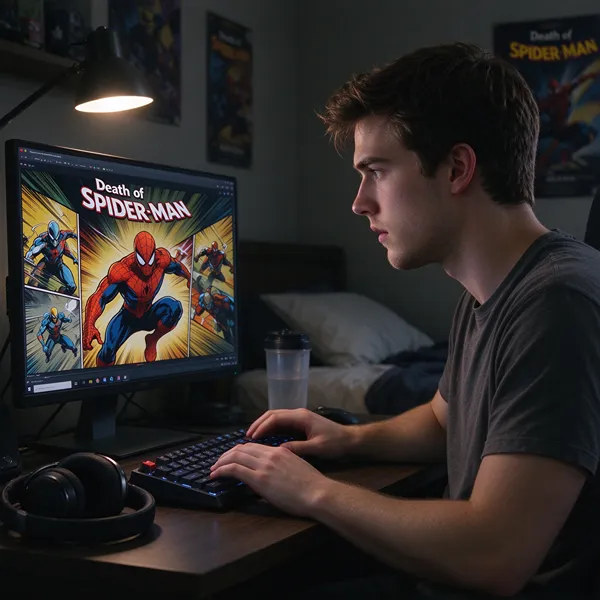
That format is useful, but it also has a clear limit: it can heighten the emotion of the comic, yet it does not become the official source. If accuracy matters to you, use it as a companion to the issues rather than the final reference.
Original comic art with limited animation
The adaptation keeps the comic art at the center. Instead of rebuilding the story with new animation, it relies on panel movement, zooms, cropping, impact shakes, and timing to guide the viewer through the scene.
That can be a strength for this specific story. The printed pages already carry the emotional weight, so the limited animation works more like emphasis than reinvention. For someone who does not usually read comics, those small movements can make the action easier to follow.
Voice acting and sound design
Voice acting and sound design do much of the heavy lifting. Peter's exhaustion, Goblin's aggression, and the silence after the fight all become easier to process when the images are supported by performance and sound.
- Voice work gives Peter's pain and fear a more immediate human quality.
- Sound effects make impacts and destruction feel heavier than static panels alone.
- Music and pauses help the ending slow down instead of rushing past the grief.
A strong focus on Peter's final moments
The fan film narrows the story around Peter's final moments, which is why it works well for viewers who are not deeply familiar with Ultimate Marvel continuity. It does not need to explain every connected event to make the central tragedy clear.
This focus also creates the main trade-off. If you want the most emotional, watchable version of the ending, the motion comic is easy to approach. If you want the cleanest understanding of what officially happens and what follows, the comics give you the better foundation.
Conclusion
The motion comic is most useful as an emotional entry point into Ultimate Peter Parker's death, especially if you want to see the final battle presented with voices, music, and pacing. Treat it as a fan-made retelling, then read Ultimate Comics Spider-Man 158–160, add Avengers vs. New Ultimates issue 4 for context, and continue into Ultimate Fallout if you want to see why this death matters beyond the final scene.