The invincible motion comic is best understood as the 2008 MTV version of Robert Kirkman's comic: not a full cartoon, but a voiced, edited presentation of the early issues. If you are coming from the Prime Video series, the two things to know first are simple: it adapted the beginning of Mark Grayson's story, and it is much harder to watch officially today than the newer show.
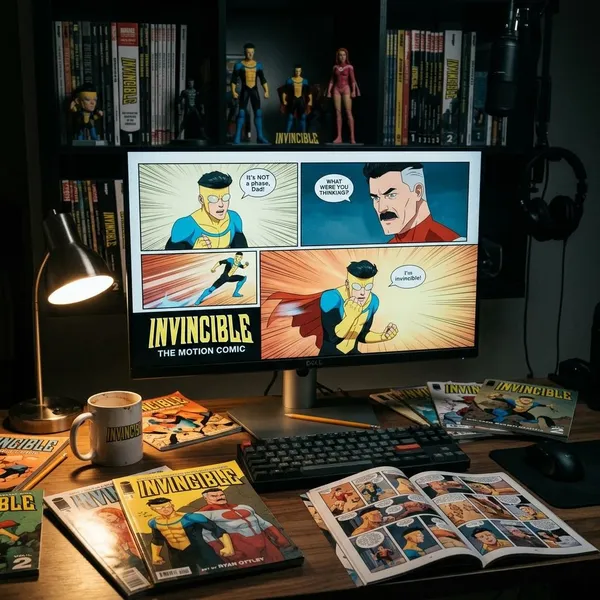
What part of Invincible did the motion comic adapt?
The motion comic focused on the opening stretch of Invincible, where Mark gets his powers, steps into the Invincible identity, and starts to see cracks in the heroic image around Omni-Man. That makes it more of an origin adaptation than a broad version of the whole comic run.
For a Prime Video viewer, this matters because the motion comic is not trying to be a modern reworking. It is closer to a guided version of the page, with voices and sound added to the comic's early structure.
The adaptation covers the first 12 comic issues
It is generally described as covering the first 12 issues of the comic. That is the part readers should check first if they want to compare the motion comic with the printed story, because it contains the main setup: Mark's origin, his early hero work, key supporting characters, and the growing tension around his father.
The limited format also makes more sense with this section than it would with a later, larger arc. The early issues rely heavily on character setup, family tension, and panel composition, so the motion-comic style can preserve the flow without needing to recreate every action scene from scratch.
Mark discovers his powers and becomes Invincible
This is the emotional entry point of the adaptation. Mark is not presented as a finished superhero; he is excited, awkward, and still figuring out what his powers mean in daily life.
- If you are new to Invincible: this part gives enough context to understand who Mark is before the story turns darker.
- If you already know the show: it is useful for seeing how plainly the comic first introduced his superhero life.
The early Omni Man storyline drives the main conflict
Omni-Man gives the motion comic its real tension. Mark's origin is the surface story, but the unease around Nolan Grayson is what keeps the early arc from feeling like a standard teenage superhero setup.
That tension works better than some people might expect in a motion comic. Suspense does not always need fluid animation; a still panel, a voice performance, and a pause can carry a lot when the scene is built around suspicion rather than spectacle.
Who voiced the Invincible motion comic?
The voice cast matters more here than it would in a normal animated series, because the visuals are intentionally limited. The actors have to carry timing, emotion, and energy that full animation would usually help provide.
The main credited performers most fans look for are Patrick Cavanaugh as Mark Grayson, Pete Sepenuk as Omni-Man, Wendy Allyn as Atom Eve, and Victoria Garcia Kelleher as Debbie Grayson.
Patrick Cavanaugh as Mark Grayson
Patrick Cavanaugh voiced Mark Grayson in the motion comic. His version fits the format: younger, more direct, and closely tied to the comic's original pacing rather than a larger television performance.
The useful comparison is not simply "better or worse than Steven Yeun." Cavanaugh is voicing a Mark who lives inside edited comic panels, so small shifts in embarrassment, confidence, or panic have to do more of the work.
Pete Sepenuk as Omni Man
Sepenuk's Omni-Man needs to sound heroic enough for the premise to work, but controlled enough that viewers can feel something is wrong. That balance is especially important because the early story depends on Nolan's public image and private threat existing at the same time.
Wendy Allyn as Atom Eve
Atom Eve gives the early story a wider superhero world beyond the Grayson household, and Wendy Allyn's performance helps keep her from feeling like background decoration. Eve needs confidence and warmth, because she is one of the characters who makes Mark's new life feel social rather than purely personal.
Victoria Garcia Kelleher as Debbie Grayson
Debbie Grayson is easy to undervalue if someone is only looking for superhero action, but she is one of the reasons the early story has weight. Victoria Garcia Kelleher's role helps ground the family side of the adaptation, especially because the format depends so much on believable vocal delivery.
For viewers comparing versions, Debbie is also a good test case. If a scene with limited movement still feels tense or human, the voice work is doing its job.
Where can you watch the Invincible motion comic?
The practical answer is: do not expect it to be easy to find through normal official streaming. The motion comic had a real release, but it does not appear to have the stable availability that modern viewers expect from a current catalog title.
If your goal is simply to watch Invincible, the Prime Video series is the straightforward option. If your goal is to research the 2008 MTV adaptation specifically, you will probably need to treat it more like hard-to-find digital media.
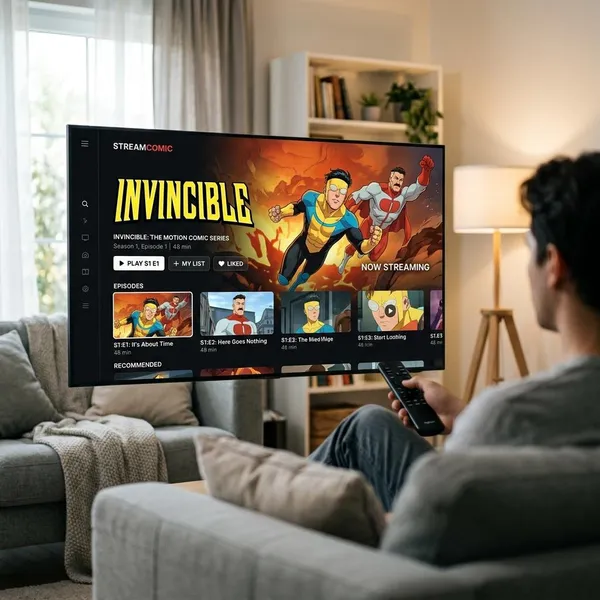
It originally appeared on MTV2 and digital stores
The original release was tied to MTV2 and digital storefronts such as iTunes. That fits the late-2000s moment, when networks were experimenting with downloadable video and lower-cost comic adaptations.
This also explains the current problem. A digital release from that period could disappear when storefronts changed, pages were removed, or rights were no longer actively maintained. It was not built like a modern streaming original with long-term platform visibility.
Most original official listings are no longer available
Do not rely on old MTV pages or outdated store links as proof that the motion comic can still be watched officially. Some records may survive in search results, archives, databases, or fan references, but that is different from an active, public viewing option.
- Check the source date: old listings may describe availability that no longer exists.
- Separate records from access: a database entry can confirm the release without offering the video.
- Be careful with uploads: clips, edits, and mislabeled files can look convincing at a glance.
Parts of the series resurfaced through preservation efforts
Some surviving material has resurfaced through archiving and fan preservation, but it is safer to treat those finds as partial unless the details match known records. Runtime, credits, episode labeling, and the visual style are useful checks before assuming a file is complete or authentic.
For a casual fan, that may be more effort than it is worth. For someone researching lost media, adaptation history, or early digital comics, the search itself is part of the appeal because it shows how easily niche web-era releases can slip out of official circulation.
Invincible motion comic vs Prime Video series
The motion comic and the Prime Video series are not competing versions of the same experience. One is a page-based adaptation that keeps close to the comic's early presentation; the other is a full animated series built for modern television pacing.
A good way to choose between them is to ask what you want from the viewing. If you want source closeness, the motion comic is the more interesting artifact. If you want the strongest screen version, the Prime Video series is the more complete adaptation.
Comic panels versus full animation
The motion comic uses existing comic panels with limited movement, camera-style pans, transitions, voices, and sound. It feels closer to reading the comic with direction added than watching a fully animated episode.
The Prime Video series can stage action, facial expressions, and timing much more freely. That makes a big difference in fights and emotional scenes, especially for viewers who expect animation to move like television rather than enhanced comic art.
| Viewer situation | Better fit |
|---|---|
| You want to study the original comic's early layout and pacing | Motion comic |
| You want fluid action and modern episode structure | Prime Video series |
| You are researching early Invincible media history | Motion comic |
| You are watching casually for entertainment | Prime Video series |
Close comic adaptation versus reworked storytelling
Prime Video reworks the material more because it has to function as serialized television. Scenes can be rearranged, supporting characters can be expanded, and reveals can be paced for an audience watching episodes rather than turning pages.
The motion comic stays closer to the original presentation because its foundation is the comic art itself. That closeness is the main reason to seek it out, even if the format now feels dated.
Patrick Cavanaugh versus Steven Yeun as Mark
The actor comparison is really a format comparison. Patrick Cavanaugh's Mark belongs to a restrained motion-comic production, while Steven Yeun's Mark is written and performed for a much larger animated series with more room for emotional swings.
If you are used to Yeun's performance first, Cavanaugh may feel smaller in scale. That does not make it irrelevant; it shows what Mark sounded like in an earlier, more niche adaptation before Invincible became a mainstream streaming property.
Conclusion
The 2008 motion comic is worth knowing about if you care about how Invincible reached screens before Prime Video, but it is not the easiest or most polished way to experience the story today. Treat it as a close-to-the-page adaptation of the first 12 issues and a piece of early digital media history; for regular viewing, the modern animated series is the more accessible choice.